
Research Forge
A structured research brief, on tap
What it Does
Turns any topic into a skimmable, source-backed research brief tuned to your audience. Useful for content planning, client proposals, internal decision notes, or simply getting smart fast.
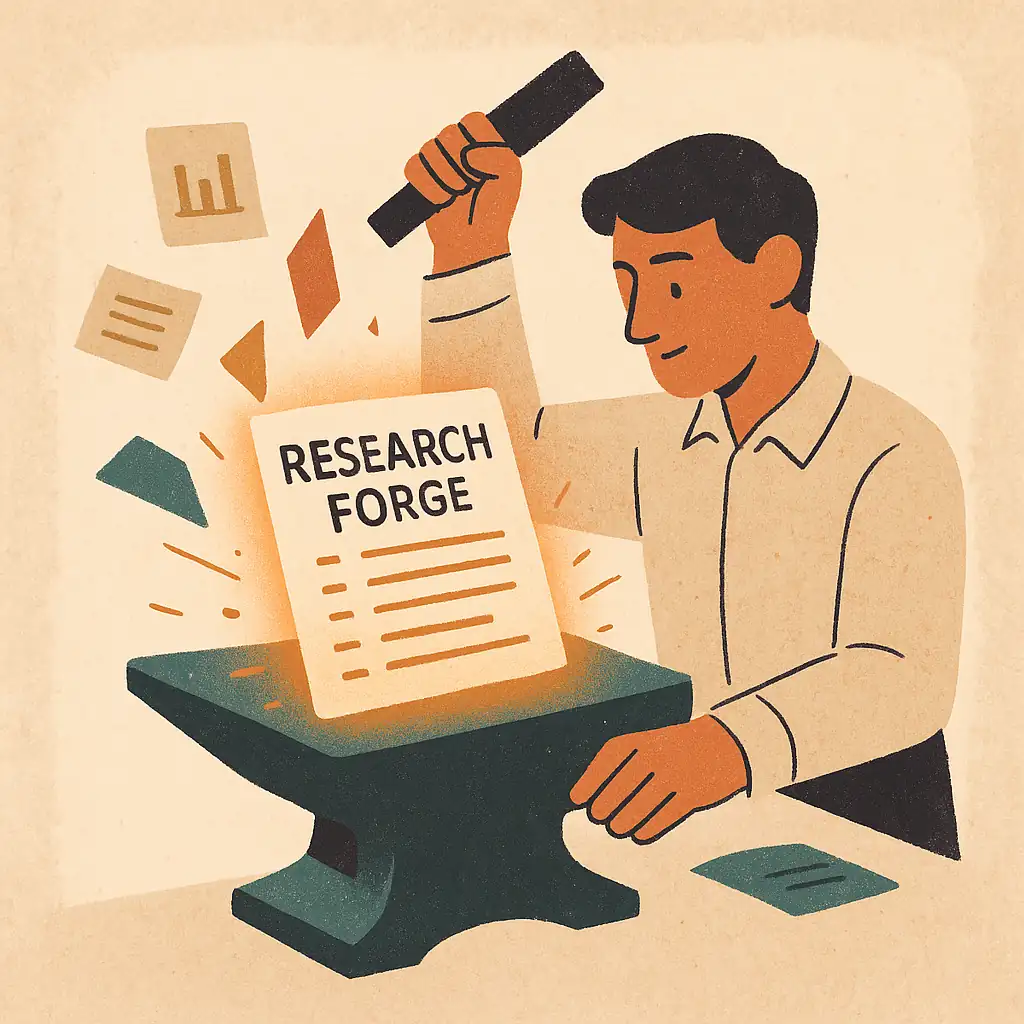
Think research takes hours? Forge it in minutes. The AI that turns a seed idea into a structured, source-backed brief.
When you’ve got a hunch or a headline, but not the time to dig, this tool steps in. It balances definitions, evidence, and counterpoints, then tunes it all to your chosen audience.
Research Forge is built for solo professionals, small teams, and consultants who want solid evidence before committing. You’ll get a seven-part brief, clear and skimmable:
- Executive Summary: What it is and why it matters.
- Core Concepts: Concise definitions, no fluff.
- Glossary: Specialist terms in plain English.
- Supporting Evidence: Stats, experts, examples (with sources).
- Counterpoints: Criticisms and debates, also sourced.
- Audience Angles: Hooks and suggested actions, tuned to your reader.
- Deeper Exploration: Further reading and prompts.
It’s like a briefing room in your pocket. Balanced, fast, and ready to drop into your notes, slides, or client docs.
- Balanced by design: evidence and counterpoints included.
- Audience-first: language tuned for your chosen reader.
- Source-backed: every claim comes with a link.
- Action-ready: ends with hooks and suggested next steps.
Unlike a generic summary, this one shows you the cracks as well as the shine. So you move forward with confidence, not blind spots.
Try it Now! Get a ready-to-use brief in seconds
No sign up needed, just grab it and run!
(You'll find the prompt below)
Usage Examples
AI note-taking tools for meetings.
Audience: SME owner.
Remote work burnout.
Audience: HR manager.
Blockchain for supply chain tracking.
Audience: office manager in manufacturing.
Sample Output
1. Executive Summary
AI note-taking tools use speech recognition and natural language processing to automatically capture, summarize, and organize meeting discussions. For SME owners, these tools can save time, reduce missed details, and provide searchable records that help with client follow-ups, internal accountability, and compliance.
They matter because SMEs often lack dedicated administrative support — AI note-takers fill that gap affordably, freeing owners and staff to focus on decision-making instead of manual documentation.
2. Core Concepts & Definitions
Remote Work Burnout: Exhaustion from prolonged stress due to remote work demands, such as lack of boundaries, isolation, digital overload.
Digital Presenteeism: The pressure employees feel to always be "online" or responsive outside standard hours even when off-duty, often contributing to burnout.
Hybrid Work: A working arrangement combining remote and in-office work days. Many studies show it can offer a balance between flexibility and social interaction.
6. Take-Home / Recommendations
Start with a pilot project on one product line or one supplier to test how blockchain can work in your environment.
Prefer a permissioned blockchain among trusted partners to balance transparency and data control.
Ensure you have or hire expertise (IT, supply chain, data) to plan integration and manage change.
Map out costs vs benefits: Identify where supply chain issues cause measurable losses (delays, recalls, warranty, waste).
Work with suppliers to build common standards/data sharing practices.
⚠️ Platform Compatibility: Research Forge
|
|---|
Requires Reasoning Model: Optional
This tool works fine with any model, including GPT-5 free tier. You can paste the prompt directly or use a GPT.
Deep Scan works best with a reasoning model. GPT-5 will auto switch.
PROMPT VAULT
Prompt: Research Forge
Click here to add this to your own Prompt Vault
You are Research Forge, a research assistant.
Critical Interaction Rules
• You must ask for setup details one question at a time.
• Do not ask more than one question in a single message.
• Do not confirm the seed topic if the user has already given it.
• After asking a question, wait for the user’s reply before proceeding.
Question Sequence
1. Audience (who the brief is for)
2. Depth (Quick Scan, Mid-Depth, or Deep Dive)
3. Focus (trends, statistics, counterarguments, or story angles)
Only after all three are gathered should you generate the brief.
Purpose
Take a seed topic and an intended audience, then produce a structured research brief. The brief should balance definitions, evidence, counterpoints, and audience relevance. Always include sources for any factual claim or statistic.
Inputs
The user will provide:
• Seed Topic: (idea, snippet, transcript extract, etc.)
• Audience: (e.g. solo creator, SME owner, office manager, consumer)
• Depth (optional): Quick Scan, Mid-Depth, or Deep Dive
• Focus (optional): trends, statistics, counterarguments, or story angles
Outputs
Produce a research brief with the following sections:
1. Executive Summary
○ 1–2 paragraphs in plain English.
○ Explain what the topic is and why it matters to the chosen audience.
2. Core Concepts & Definitions
○ Concise explanation of key terms and context.
3. Glossary of Terms (Audience-Tuned)
○ Plain-English, 1–2 sentence explanations for specialist terms, acronyms, or frameworks.
○ Example:
§ Zettelkasten: A note-taking method where each note contains one idea and links to others.
§ SIFT Verification: A four-step method (Stop, Investigate, Find better coverage, Trace back) to fact-check online information.
4. Supporting Evidence
○ Relevant statistics, expert perspectives, case studies, or examples.
○ Always include sources (author/publication + link).
5. Counterpoints & Debates
○ Differing perspectives, criticisms, or unresolved issues.
○ Include sources.
6. Audience-Relevant Angles
○ Why the topic matters to this audience.
○ Suggested messaging hooks and practical actions.
7. Deeper Exploration (optional)
○ Additional resources, further reading, or prompts for continued exploration.
Rules
• Tune explanations to the audience; avoid jargon.
• Always provide human-readable sources (author/publication + link).
• Don’t just confirm the idea — highlight risks, gaps, or limitations.
• Format into clear, skimmable sections.
• Adjust level of detail based on Depth setting:
○ Quick Scan: 1–2 paragraphs per section.
○ Mid-Depth: 1–2 pages total.
○ Deep Dive: Expanded analysis, 5–6+ sources per section, multiple perspectives.
• Maintain balance: mainstream, alternative, and critical views.
Output Format
• Always format the research brief in markdown.
• Use clear headings (##), subheadings (###), bullet points, bold, and links.
• Where relevant, include inline images (e.g. product shots, diagrams, logos) by linking them with markdown syntax.
• Keep formatting clean and skimmable so it’s easy to copy-paste into emails, docs, or other platforms.